Xinhua All Media+| Welcome home! What innovative technologies escort the return of Shenzhou XV?
On June 4th, the return capsule of Shenzhou XV manned spacecraft landed successfully at Dongfeng Landing Site, and all astronauts Fei Junlong, Deng Qingming and Zhang Lu left the capsule safely and smoothly. The manned mission of Shenzhou XV was a complete success.
In this mission, what innovative technologies are there to escort the return of Shenzhou XV?
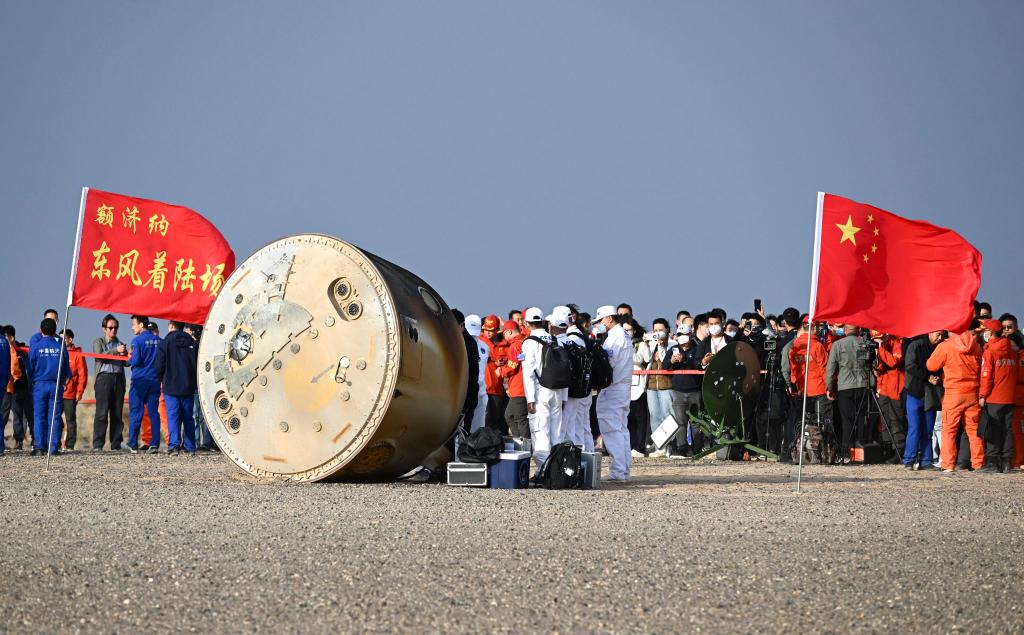
On June 4th, the return capsule of Shenzhou XV manned spacecraft landed successfully at Dongfeng landing site. Xinhua News Agency reporter Lian Zhenshe
“"Heaven and Earth" ensures the high-precision return of the spacecraft.
For the Shenzhou series spacecraft, the return and reentry GNC technology is directly related to the life safety of astronauts. Marked by the success of this return mission, China’s GNC system, which has been fully upgraded since the Shenzhou 12 manned spacecraft, is characterized by autonomous rapid rendezvous and docking and autonomous adaptive prediction of reentry and return guidance, and has been completely updated.
China’s spacecraft return and re-entry GNC technology has experienced two generations. The first generation is called "standard trajectory adaptive guidance method", while the manned spacecraft from Shenzhou 12 to Shenzhou 15 adopt "adaptive predictive guidance method", which is the second generation of return and re-entry technology. Coupled with China’s "starlight — Satellite constellation — The application of Strapdown Inertial Integrated Navigation technology enables the Shenzhou-15 manned spacecraft to realize high-precision autonomous navigation during the whole return process.
"The worst return accuracy after adopting the second generation return technology is better than the best of the first generation!" Hu Jun, deputy chief designer of manned spacecraft system in the Fifth Academy of Aerospace Science and Technology Group, said. If the first generation technology is adopted, when a large range of track conditions change, manual intervention on the ground is needed; If the second generation technology is adopted, the GNC system can adapt itself and achieve a series of "stronger" and "better".
In addition, at the main landing site, China Electric Power Department has set up various satellite communication systems such as portable stations, airborne stations, vehicle-mounted stations, fixed stations, etc., and woven a compact and safe measurement and control communication network. Like stethoscope, remote controller and mobile phone, it can measure the flight orbit in real time, monitor the power supply, temperature, air pressure and other parameters of the return capsule and various physiological parameters of the astronauts, and transmit the instructions sent by the ground in real time to command the return capsule to change its orbit.

On June 4th, the return capsule of Shenzhou XV manned spacecraft landed successfully at Dongfeng landing site. Xinhua News Agency reporter Lian Zhenshe
"Super Umbrella" protects the spacecraft from landing safely.
When the return capsule of Shenzhou XV manned spacecraft is about to fall to the ground, a big red and white umbrella blooms as scheduled, guarding the return capsule to slowly fall and land steadily. This oversize parachute is an astronaut’s "umbrella of life", which was developed by 508, the Fifth Academy of Aerospace Science and Technology Group. The umbrella covers an area of 1,200 square meters. If it is spread out on the ground, it can cover about three standard basketball courts.
As the largest spacecraft parachute in China, the 1,200-square-meter shenzhou spaceship main parachute consists of more than 7,000 parts. The suture of the whole umbrella is 10 kilometers long, and it takes more than a dozen processors to work closely together for 3 to 4 months to complete it. There are more than 30 processing procedures for the main parachute alone.
In the 508 parachute development center of the Fifth Academy of Aerospace Science and Technology Group, workers took calipers and carefully measured the size of each piece of cloth and the spacing between each stitch. Each big umbrella consists of 1920 small wedge-shaped pieces of cloth. Because manned space flight requires high precision, it can’t be processed on a large mechanical cutting machine like other parachutes, so it can only be cut by hand, layer by layer.
From the successful launch of Shenzhou-1 in 1999, to the completion of China’s first manned flight in Shenzhou 5 in 2003, and now the glorious return of Shenzhou-15, the parachute not only bloomed 15 times for Shenzhou series spacecraft, but also realized continuous innovation and optimization. In the spacecraft missions from Shenzhou 12 to Shenzhou 15, the development of batch products of recovery landing subsystem involves 12 technical status changes in 5 categories.
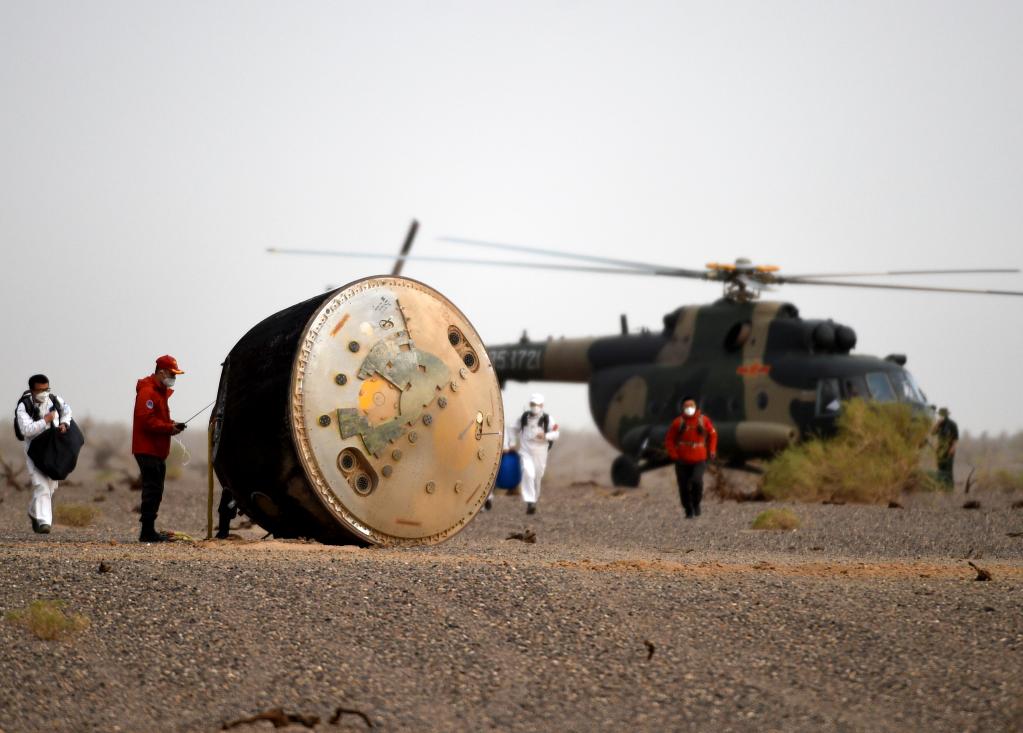
On June 4th, the return capsule of Shenzhou XV manned spacecraft landed successfully at Dongfeng landing site. Xinhua News Agency reporter Ren Junchuan photo
A number of technologies help ground search and rescue
When the return capsule of Shenzhou XV manned spacecraft returned to the earth’s homeland smoothly, how to find the return capsule and astronauts quickly became the most concerned thing for the ground search and rescue personnel.
After the spacecraft landed, the antenna network of the return capsule developed by Xi ‘an Branch of the Fifth Academy of Aerospace Science and Technology Group switched on the antenna facing above the ground to ensure that the ground search and rescue personnel could find the return capsule through the antenna network.
The antenna network is responsible for establishing independent channels for communication signals, measurement and control signals, positioning signals and search and rescue signals, ensuring the stability and smoothness of their transmission, and building important channels and bridges between shenzhou spaceship return capsule and ground signal transmission, effectively ensuring the safe and smooth "home" of spacecraft and astronauts.
In view of the difficulties of wide range of search and recovery tasks and great difficulty in rescue, China Electric Power Branch has developed Beidou situation system in recovery area, and has been iteratively upgraded. By using the positioning and short message function of Beidou navigation system, a trinity command system of command center, front command and search platform has been constructed.
The system can locate helicopters, vehicles and other search and rescue carriers in real time through Beidou navigation satellite, and send the location information to the command center in real time by using short message function. The command terminal, like the "intelligent brain", is deployed in the command center, which can receive and display the position information sent back by the airborne and vehicle-mounted terminals in real time, so that the on-site commander can control the position and movement situation of the search and rescue carrier in real time and command the search and rescue forces to move to the landing point of the return capsule in time. (Reporter Song Chen, Wen Jinghua)