Villagers in Shangluo, Shaanxi Province collectively went out to sell blood-stained hepatitis C, and some people tied the grave in advance.
In Shangzhou District, Shangluo City, deep in the Qinling Mountains, there is a remote village, Nanwan Village. Many villagers in the village are suffering from hepatitis C. Because they have hepatitis C, they have spent almost all their savings, and even the whole family is suffering from hepatitis C. Among them, some people have died of vomiting blood because they have no money to treat it, while others are waiting to die …
Hepatitis C, the word has become a nightmare for everyone in the village. Local official surveys have confirmed that many villagers’ infection with hepatitis C is related to their collective experience of "selling blood" in the 1970s and 1980s. Recently, the reporter from Huashang Daily visited the village and had face-to-face communication with hepatitis C patients. Through their stories, we walked into the inner world of hepatitis C carriers.
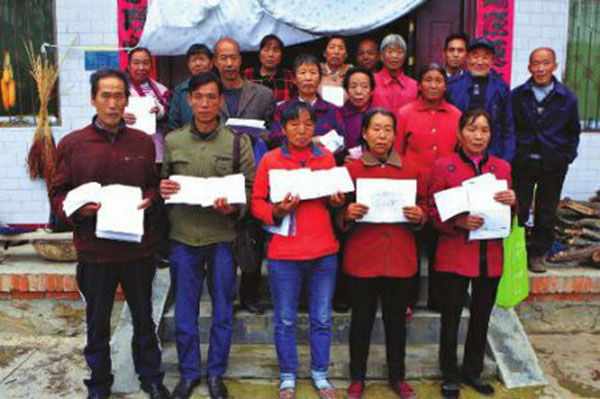
Villagers selling blood
Cases:
I am afraid that people will "walk away" and my family will tie the grave in advance.
On October 10, the gloomy sky dripped raindrops from time to time, which made people feel depressed and dreary on such a cold day. The reporter from Huashang Daily drove along the country road to Nanwan Village, Dajing Town, Shangzhou District, deep in the mountains. From time to time, older villagers walked slowly, and almost all the young people in the village went out to work.
At a terrace next to a fork in the road, four new two-story houses look very conspicuous. In the yard, 60-year-old Wang Kanliang and his wife sit on stools and look at the nearby mountains. They exchange a few words from time to time. Although the house behind them is newly built, there are few decent pieces of furniture in the house, and there are still infusion bottles hanging at the door of the small house. Since the house was built, the couple became ill. The son went out to work to earn money, and the daughter was married, leaving only the couple at home.
Wang Kanliang and his wife Ding Caifeng are both patients with liver cirrhosis. In 2013, Wang Kanliang went to the hospital for examination because he felt weak and his chest was stuffy, and found that he was suffering from hepatitis C. Despite active treatment, he still developed liver cirrhosis. Last year, Ding Caifeng was also diagnosed with cirrhosis. One day in early September this year, Ding Caifeng suddenly vomited blood. Wang Kanliang quickly called her daughter living in the urban area and sent Ding Caifeng to the hospital. After staying in the hospital for less than half a month and spending nearly 10,000 yuan, Ding Caifeng went home to recuperate.
In fact, the situation of vomiting blood has appeared more than once. In March, Ding Caifeng appeared once. At that time, during the treatment in the hospital, I was afraid that people would "go away" and it was too late to deal with the aftermath, so the family took advantage of it to hoop the grave in advance. In the past two or three years, Wang Kanliang and his wife have lived in hospitals many times. It can be said that they have survived from the gate of hell many times.
"Look, this is my wife and I’s medical diagnosis in recent years, and this pile of medicine. This box costs 3,000 yuan, which is really unaffordable." When Wang Kanliang said this, he bowed his head and was silent for a long time. "I have spent all my money on seeing a doctor. I can’t drag my children any longer. Let fate take its course." Wang Kanliang’s daughter, Wang Jianmin, said that the eldest brother was a farmer who supported his family by going out to work, and her family was in a bad situation. They also wanted their parents to be hospitalized, but the cost was too high. Last time, my mother insisted on being discharged from the hospital, and she originally stayed for half a month.
In front of the hillside not far from Wang Kan Liangjia, a new tomb was just built in July, which was prepared for Wang Kanliang and his wife. People are still alive, but the grave has been strapped, which is quite common in rural areas. Because of the experience of falling ill, the family had to start preparing for the funeral in advance.
The ex-husband died of cirrhosis, and the current husband suffered from hepatitis C.
In Nanwan Village, it is not uncommon for Wang Kanliang and his wife to do so. Lu Shuxia, 57, was hospitalized for hepatitis C in May last year. The diagnosis was viral hepatitis, type C, chronic and moderate. Her current husband has been diagnosed with hepatitis C five years ago, but the situation is slightly better, relying on drugs to maintain, because of fatigue and dull pain in the liver, the couple can’t do farm work at all.
Lu Shuxia is a native of bad karma. Her ex-husband died of cirrhosis 10 years ago. Up to now, she can still clearly remember her ex-husband’s illness. "At one or two o’clock in the evening, I started vomiting blood, and the neighbors quickly used the shelf car to send people to the ditch." Lu Shuxia recalled that after being sent to Mizoguchi, he was taken to a big hospital. After four or five days of treatment, the hospital sent people back again, saying that people were dying and left the next day after returning home. After her ex-husband left, no one did farm work at home, and her daughter was not married, so Lu Shuxia and her current husband (in the same village) came together, but they all got sick later, because they had no money to treat the disease, so they could only take some medicine to maintain it slowly. "I am dying when I am sick. There is no way but to wait for death." Lu Shuxia sighed and looked at the sky helplessly.
A family, four pillars all suffer from hepatitis C.
Hepatitis C is an infectious disease. At first, the villagers didn’t know about this disease. Some people joked and laughed at themselves. "Hepatitis C" thought about whether it was edible biscuits, but more people came later. Everyone gradually learned about this disease, but in the villagers’ hearts, they still didn’t want more people to know, fearing that it would be shameful to spread it. In the early stage, some people didn’t check it, but they carried it at home, and they didn’t actively treat it when they found it. Of course, there is still a more realistic problem here that there is no money for treatment.
"You can report it, but don’t mention specific names. It’s not good to spread it." Luo Shuqiang, a 51-year-old villager, quickly added that it doesn’t matter if there are more people who are sick anyway. Everyone cares about each other, and many folks on the side laughed.
Luo Shuqiang was diagnosed with hepatitis C in June 2015. He spent more than 70,000 yuan on surgery and was treated with interferon at home. For more than a year, he had to take interferon every other day. The side effects of the drug made him feel weak and didn’t want to eat.
Luo Shuqiang is the hope of the family and the main labor force. Now that he is sick, his family is living a very tight life. Luo Shuqiang said that there are four brothers, their father is suffering from hepatitis C, and their eldest brother and fourth brother are also suffering from hepatitis C. All four people in a family are sick, and all four are main laborers, which makes their family unbearable.
The 56-year-old Wang Laishan is thin and weak. His home is not far from Luo Shuqiang’s. The four adobe houses look shabby, and the home is very simple. There are various medicines on the cabinet. His wife is deaf, his eldest daughter is married and mentally ill, and his youngest daughter is married and working in Guangdong. He works at home during the busy farming season and works in Xi ‘an to earn money during the slack farming season.
In March of this year, Wang Laishan felt that his heart ached and he was sleepy. He went to the hospital to check that it was hepatitis C, and then he went to Xi ‘an to review and diagnose hepatitis C. "This is the case in my family. I take care of myself when I am hospitalized. I can’t help it." Wang Laishan said that in order to treat the disease, he has already spent 60,000 yuan. In addition to borrowing from relatives, he also borrowed 30,000 yuan. Now he sells fruits in Xi’ an and buys medicine to maintain treatment. Wang Laishan said that his eldest brother also died of cirrhosis. At that time, he sent his eldest brother away. He was worried about his illness. If something happened one day, I really dare not think about it. ……
Etiology:
In the 1970s and 1980s, some villagers collectively went out to sell blood.

Why are there so many hepatitis C patients in Nanwan Village? According to the villagers’ memories, in 1970s and 1980s, Shangluo, located in the depths of Qinling Mountains, was economically backward, and many people chose to go out to sell blood. All the villagers mentioned above had the experience of selling blood in that era.
"We are relatively poor here. At that time, the’ blood head’ informed the people who sold blood, and then organized everyone to sell blood in Shangluo, Xi’ an and Gansu." Wang Kanliang and his wife Ding Caifeng were still strong young people when they sold blood. They recalled that at that time, in a village, word spread from mouth to mouth, and everyone sold blood in batches. Almost every week, people in the village sold blood. One person could earn 36 yuan by drawing 300 ml of blood at a time. Some villagers regarded blood sales as their main family income because they had no way to earn money.
"Up to now, I can still remember that every time I go, everyone is in groups, talking and laughing, because the mountain people have never been far away, and they also regard selling blood as a pleasure." Ding Caifeng said that after finishing the examination at the place, every time I went to stretch my arm, people began to draw blood. After the blood is sold, the money is given to the "blood head", and everyone can get quilts, bread and other gifts after the blood is pumped. The villagers will take bread home for their children to eat and subsidize their families with the money from selling blood.
The last time Ding Caifeng sold blood was in Tianshui City, Gansu Province. In the early 1990s, she stayed in a hotel for a month and waited in line to sell blood. Finally, after examination, the medical staff told her that she had hepatitis C and could not donate blood. Since then, she has never sold blood again. What disease is hepatitis C? Ding Caifeng didn’t know it at that time, so she didn’t care.
Lu Shuxia also sold blood with her ex-husband, including her current husband. She said that at that time, some people sold blood and some sold plasma. Selling whole blood was a one-time blood donation. Selling plasma was to extract the plasma from the blood after pumping blood, and return the remaining blood protein to the blood seller himself.
This crazy blood selling behavior didn’t stop until the 1990s, and these blood sellers returned to the village one after another. At that time, some people were infected with hepatitis C, but it didn’t attract enough attention.
It is easy to be infected with hepatitis C if the separated blood protein is reinfused.
In 1970s and 1980s, due to economic difficulties, villagers with good health in Nanwan Village successively donated blood in Xi ‘an, Baoji, Weinan, Tianshui, Gansu and Shangluo. Especially from 1975 to 1985, paid blood donation was widespread and frequent, and both whole blood and plasma were donated. From 1986 to 1990, most paid blood donors were eliminated due to unqualified blood, and paid blood donation gradually stopped after 1990.
"Before the 1990 s, blood collection basically did not detect hepatitis C, and technical means could not be achieved in all aspects, just detecting AIDS and hepatitis B." Wang Jianjun, director of the Center for Disease Control and Prevention in Shangzhou District, said that it is more serious to remove the useful components from the blood when collecting blood, and then return the remaining blood proteins to the blood sellers, which is easy to be infected with hepatitis C.
"Shangluo Blood Station was established only after the 1990s. Before that, blood management was in a rather chaotic state. Hospitals needed blood, and people were found through the’ blood head’, and only some simple examinations were conducted on blood donors." Wang Jianjun said that the economy was relatively backward at that time, and selling blood could bring a lot of income, which led many people to "sell blood."
The fact that some people in Dajing Town were infected with hepatitis C attracted the attention of Shangluo City and Shangzhou District, and Shangzhou District CDC launched an investigation. According to the investigation results, they determined that some people in Dajing Town were infected with hepatitis C due to historical reasons. After investigation by Shangluo CDC, it is believed that this does not belong to the category of explosive epidemic, and the relevant specific work is handled by Shangzhou CDC.
Shangzhou District CDC:
A total of 47 villagers were screened, and 40 people were found to be positive for hepatitis C antibody.
A survey report on hepatitis C cases in Nanwan Village of Dajing Town shows that in June this year, Shangzhou CDC, together with Dajing Town Central Health Center, conducted an epidemiological survey and collected and tested blood samples from villagers who claimed to have a history of hepatitis C but had no diagnosis basis. Forty-seven villagers were investigated twice, and 29 blood samples were collected. The results showed that 18 of them had hepatitis C diagnosis certificates from hospitals above the municipal level, and 22 of the 29 samples were positive for hepatitis C antibodies.
In this survey, 47 villagers who reported that they had hepatitis C and had a history of blood donation were investigated. All the respondents had a history of blood donation. In the two surveys, 40 people were screened positive for hepatitis C antibody, ranging from 43 years old to 72 years old, mainly between 51 and 60 years old. According to the investigation, a large number of people in Nanwan Village had a history of blood donation from 1970s to 1990s.
The report concludes that this survey mainly focuses on those who have a history of blood donation. Because of the long time interval, the survey is mainly based on self-report, and hepatitis C is an infectious disease spread in many ways, there is no hepatitis C antibody test during blood donation, and the hepatitis C antibody is not detected in time when blood donation is stopped. It does not rule out the possibility of blood transfusion infection leading to hepatitis C.
Health planning department: increase the publicity of hepatitis C prevention and treatment and increase the proportion of medical reimbursement.
For many villagers in Nanwan Village suffering from hepatitis C, Wang Chao, deputy mayor of Dajing Town, and Guo Ying, president of Dajing Town Central Health Center, said that this was a historical reason. At that time, the sanitary and technical conditions could not be met, and hepatitis C could not be detected when donating blood. They have increased publicity to the villagers to let everyone know how to prevent and treat hepatitis C, and the other is to increase the reimbursement ratio of rural cooperative medical treatment.
Wang Jianjun said that they only received feedback to investigate and did some inspections, but did not conduct a comprehensive survey. According to the existing conditions, the whole region can’t make a thorough survey of all people, only where there are problems and where to carry out work. Shangluo is a poverty-stricken area. According to their preliminary estimation, there were more than a dozen villages selling blood in that year. If it is unrealistic to conduct a general survey, even if it is found out, how to solve it is still a problem.
"In the 1980 s and 1990 s, the masses spontaneously organized blood sales. Under that special background, medical testing conditions could not be met, which caused the current situation." Arjun huang, deputy director of the Health and Family Planning Bureau of Shangzhou District, said that it is an event that belongs to a specific matter and a special background. It admits that the last time they checked Nanwan Village in Dajing Town, 40 people were suspected to be carriers of hepatitis C. This does not rule out that some people are not at home or in other villages. At present, the possibility of hepatitis C infection in Nanwan Village is relatively small.
"One is the infection caused by blood collection, and the other is that some blood is collected during blood collection, and the other blood is returned to the donor’s body, causing infection." Arjun huang said helplessly, at present, there is no census in the whole city, and the specific figures are not known. As a health planning department, it can only be health education, so that the masses can have a preliminary understanding, guide patients to make reasonable diagnosis and treatment, and carry out medical reimbursement in accordance with relevant policies.
Disease control experts: Hepatitis C can be prevented and cured without excessive panic.
"Hepatitis is divided into several types, such as A, B and C. There are many common hepatitis B. Both hepatitis B and hepatitis C are transmitted through blood, mother-to-child and sexual transmission, and belong to Class B infectious diseases." Chen Yanwei, from the Department of Epidemiology and Prevention of Shangluo CDC, said that hepatitis C is mainly transmitted by blood, and its clinical manifestations include fever, digestive tract symptoms and abnormal liver function. The chronic degree is serious, which can lead to fulminant liver failure. Hepatitis C is distributed in all counties and districts of Shangluo. After being infected with hepatitis C virus, it is not easy to be found in time because of its incubation period.
Chen yanwei said that in the past, blood management was not standardized, and some people were infected with hepatitis C in the process of selling blood. Since then, there has been a fundamental change in blood management. "It should be noted that hepatitis C is preventable and treatable. It can be cured by ribavirin and interferon at the initial stage, and patients do not need to be overly alarmed." Chen Yanwei explained that the liver has a strong detoxification function, and the nutrient transformation in the body is completed through the liver, which is equivalent to the "detoxification factory" of the human body. Generally speaking, hepatitis C is a virus, and the liver is characterized by abundant blood flow. The virus invades the liver tissue, and the liver function will be damaged. In the later stage, it is cirrhosis, and in severe cases, ascites due to cirrhosis will eventually lead to liver failure or liver cancer.
(The original title is "Villagers collectively go out to sell blood-stained hepatitis C and someone ties the grave in advance")