The "Prototype Village" of "Action to Break the Ice": How was the cancer removed?
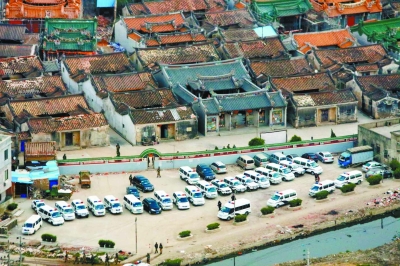

The prototype of Lin Yao East in the TV series "Action to Break the Ice" — — Cai Dongjia, the former secretary of the Party branch of Boshe Village, once built a mansion that became an unfinished project. Xinhua news agency

When the police entered the village to catch drug criminals, they were surrounded by a large number of villagers, and clan leaders took the lead in making drugs by holding village affairs … … The popular domestic drama "Action to Break the Ice" has aroused people’s attention to drug control work because of its thrilling story. This story is based on the "December 29" large-scale drug suppression operation in Guangdong at the end of 2013. One of the prototypes of Tazhai Village, the "drug nest" in the play, is Boshe Village, Jiaxi Town, Lufeng City, where nearly 3 tons of ice were seized overnight. Over the past five years or so, the reporter has interviewed many times on the spot and witnessed the changes of Boshe Village. On the eve of International Anti-drug Day, the reporter visited Boshe Village again.
This used to be a "drug village"
The seaside is now a contiguous fish and shrimp pond.
In Boshe Village, the reporter saw that both sides of the road, which used to be full of toxic waste and sewage, are now lush litchi forests full of fruits; The shacks on the beach that used to process and manufacture ice poison have been transformed into contiguous fish ponds and shrimp ponds … …
Apart from the anti-drug slogans and reward notices that can be seen everywhere, it is difficult for visitors to associate this place with the famous "drug village". At the back of the old village, a newly renovated park replaced the original overgrown barren hill. Cai Xiong, who lives nearby, said: "It used to be dark here at night, but now it has become the villagers’ favorite place." After dinner every day, the villagers dance square dance, exercise, chat and laugh everywhere in the park. Jiaxi Town Central Primary School, located in the northwest corner of the village, has newly built walls, school gates and playgrounds. Not only did the outflow of students come back one after another, but also attracted many students from other villages to study here, and the number of students in school increased from more than 300 to nearly 800.
Cai Longqiu, secretary of the Party branch of Boshe Village, told reporters that since 2014, the village has rebuilt the "two committees" of the village and gradually carried out normal village-level governance work, and the "poison haze" has also been far away from the villagers. There are a total of 14,000 people in Boshe Village. Today, there are more than 9,000 permanent residents here, and more than 5,000 people go out to work and do business. Most of the villagers who stay in the village are engaged in vegetable, fruit forest planting and aquaculture.
Tracing back to "breaking the ice"
More thrilling than the TV play.
In order to break through the fortified tower village, the police in the play explored the drug situation through informants, undercover and unannounced visits. The struggle to break through the defense line of Boshe Village is much more difficult and dangerous than the TV play. The building pattern in Boshe Village is messy and the interval is narrow. Most of them are "handshake buildings", and every household doesn’t even have a house number. "There are many eyes and ears in the village. Strangers and foreign cars will be tracked by motorcycles when they enter the village. Once they are discovered, they will be abandoned." A local policeman said.
In 2013, Guangdong anti-drug department secretly dispatched a small number of elite police officers, disguised as "scavengers" and "wage earners", and sneaked into the village to visit the drug-making target at 4 or 5 in the morning. After filming the scene, they took screenshots, positioned themselves, determined the drug-making dens and the addresses of criminal suspects, and successfully found the "gap" in Boshe Village. Lin Weidong, deputy head of the Anti-drug Brigade of Lufeng Public Security Bureau, mentioned to reporters the critical scene of being intercepted and chased by drug traffickers during the investigation: "At that time, someone threatened ‘ Whether it’s a police officer or not, it’s a police officer or a thief who killed him ’ But we didn’t back down, and we found drug-making dens and drug traffickers for the first time. " In the early morning of December 29, 2013, the Guangdong Provincial Public Security Department dispatched 4,000 police officers to collect nets from 69 key targets inside and outside Boshe Village, arrested 182 drug-related elements, smashed 77 drug-making factories and an explosive manufacturing den, and seized 2,925 kilograms of ice, 23 tons of drug-making raw materials, 9 guns and 62 bullets.
Quite different from the many gun battles at the end of the TV series, although this action was thrilling, it did not encounter much resistance. A policeman who participated in the command at the scene said: "A drug offender had a Grenade by his bed and a gun on his pillow, but we acted quickly. From breaking the door to arresting people, he didn’t have time to react at all, and there was no drop of blood in the whole operation."
Warrior who sneaked into the drug den
Someone once paid 2 million for his head.
"Compared with TV dramas, our investigation work is much more difficult." Lin Weidong, deputy head of the anti-drug brigade of Lufeng Public Security Bureau, said. Lin Weidong was one of the top ten warriors who sneaked into the drug den to make up for investigation. Lin Weidong once participated in the secret investigation of the "Thunder Anti-drug" operation, and recalled the scene at that time. At that time, he was selected as a member of the action investigation team because of his exquisite business and excellent politics, and together with more than 10 other elite police officers, he carried out the investigation of the drug-making dens in Boshe Village.
Boshe village has dense buildings, messy patterns and narrow intervals, and there is no house number in the village. The roads in the village are narrow and inconvenient. Except for two sections of cars that run through the north and south of the village, the rest sections can only pass tricycles and motorcycles.
"We gather in Jieyang at 4 o’clock every morning, arrive at Boshe at 6 o’clock in the morning, stay in the village for an hour and then quickly withdraw." Lin Weidong said that in order not to expose the secret actions, after the investigation of the day, they had to go back to work as usual. Boshe village is full of eyes and ears, and the investigating police are often followed by motorcyclists and asked. Lin Weidong and his colleagues in pairs, riding different motorcycles, secretly approached the targets such as old houses and bungalows that made drugs according to the predetermined investigation direction. In order not to be discovered, they often have to disguise themselves for investigation.
Dangerous moments often happen. He still remembers that during an investigation, he happened to see someone in the house wearing a mask to make drugs. The drug maker immediately took off his mask and called his helper to "kill" Lin Weidong. Lin Weidong and another colleague immediately turned around and fell in the chase.
After more than two months of investigation, the investigation team finally found out the terrain and the distribution of drug-making dens in Boshe village. On the day of closing the net, Lin Weidong led a team of more than 200 people to accurately find six drug-making dens. "After the closing of the network, someone will spend 2 million yuan to buy my head." Lin Weidong said with a smile, but since he is in the anti-drug business, he must be fearless.
The "drug war" is not over.
Drug control is a long-standing cause.
Action to Break the Ice ends with the arrest and sentencing of Lin Yaodong and others, but the "drug war" in reality does not end there, but the beginning of eradicating the "cancer". In the following two years, Shanwei investigated and dealt with 106 party and government cadres and police officers by initiating accountability and investigating cases, many of whom were "protective umbrellas" for drug offenders.
In the past three years, many party, government and grass-roots cadres in Lufeng have been investigated and punished for their ineffective anti-drug work. Among them, three town party committee secretaries, one deputy director of the Public Security Bureau and one director of the police station have been dismissed successively for their ineffective anti-drug work.
At the end of 2018, Lufeng took off the "poison hat" of the "national key anti-drug remediation area", but the anti-drug work did not stop there. One of the key tasks of the local government is to build a long-term anti-drug mechanism and prevent the "drug disaster" from coming back, and one of its key tasks is to help the people find employment as soon as possible. In recent years, the Shanwei Municipal Party Committee and the Municipal Government have held many job fairs in the local area, established a public employment service platform, carried out peer-to-peer recruitment, and helped drug addicts re-employment. The implementation rate of community drug rehabilitation has reached over 95%.
"Once you are blindly optimistic and do not pay attention to the construction of a long-term mechanism, drug crimes may come back and you must have a sense of crisis." The relevant person in charge of Lufeng Public Security Bureau said that drug control is a long-term cause, and the local authorities will continue to strengthen the construction of grass-roots organizations, guide the broad masses to seek proper careers from the right path, and keep approaching the goal of "a drug-free world".
According to Xinhua Viewpoint Nanfang Daily and Guangzhou Daily